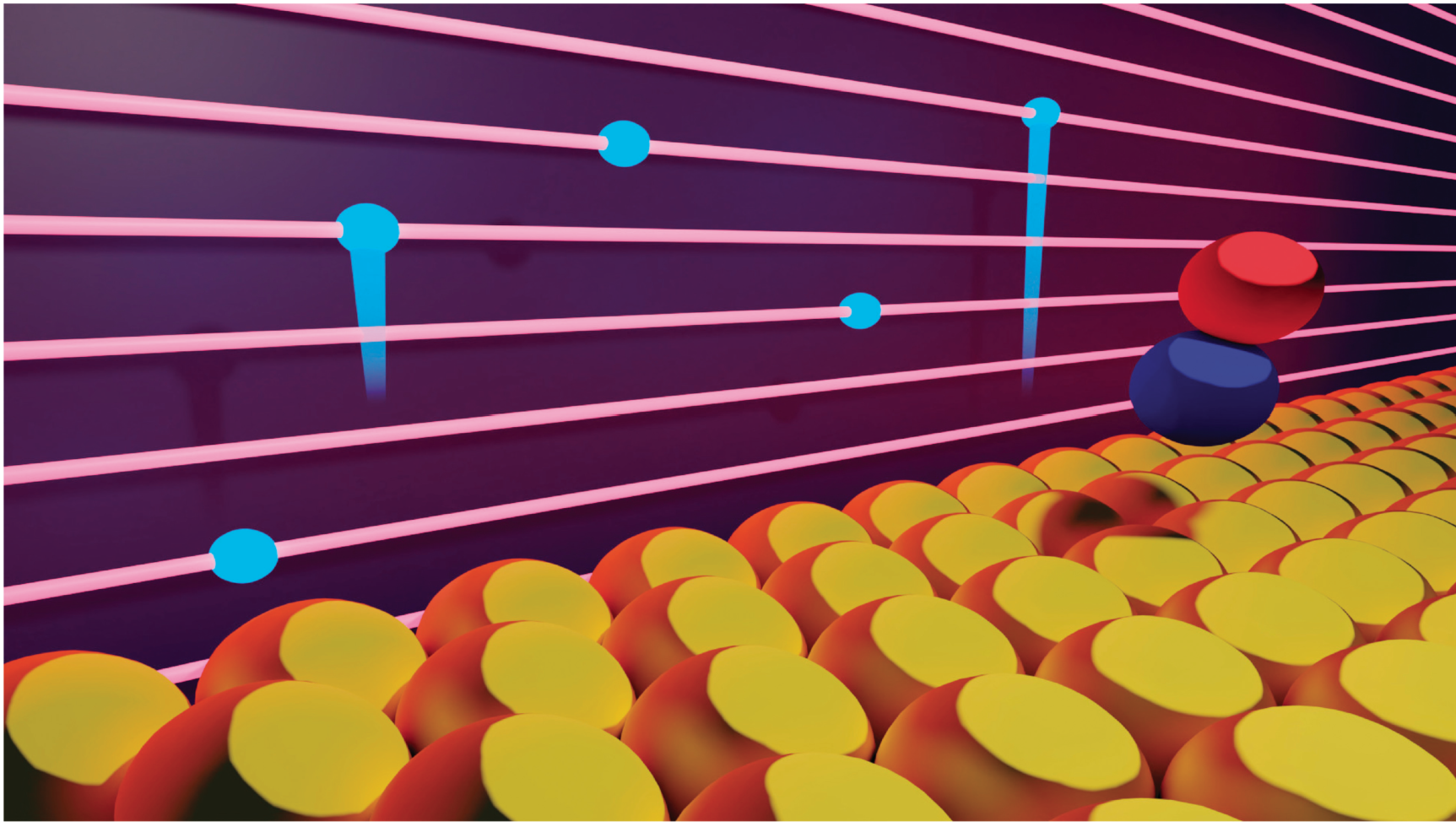
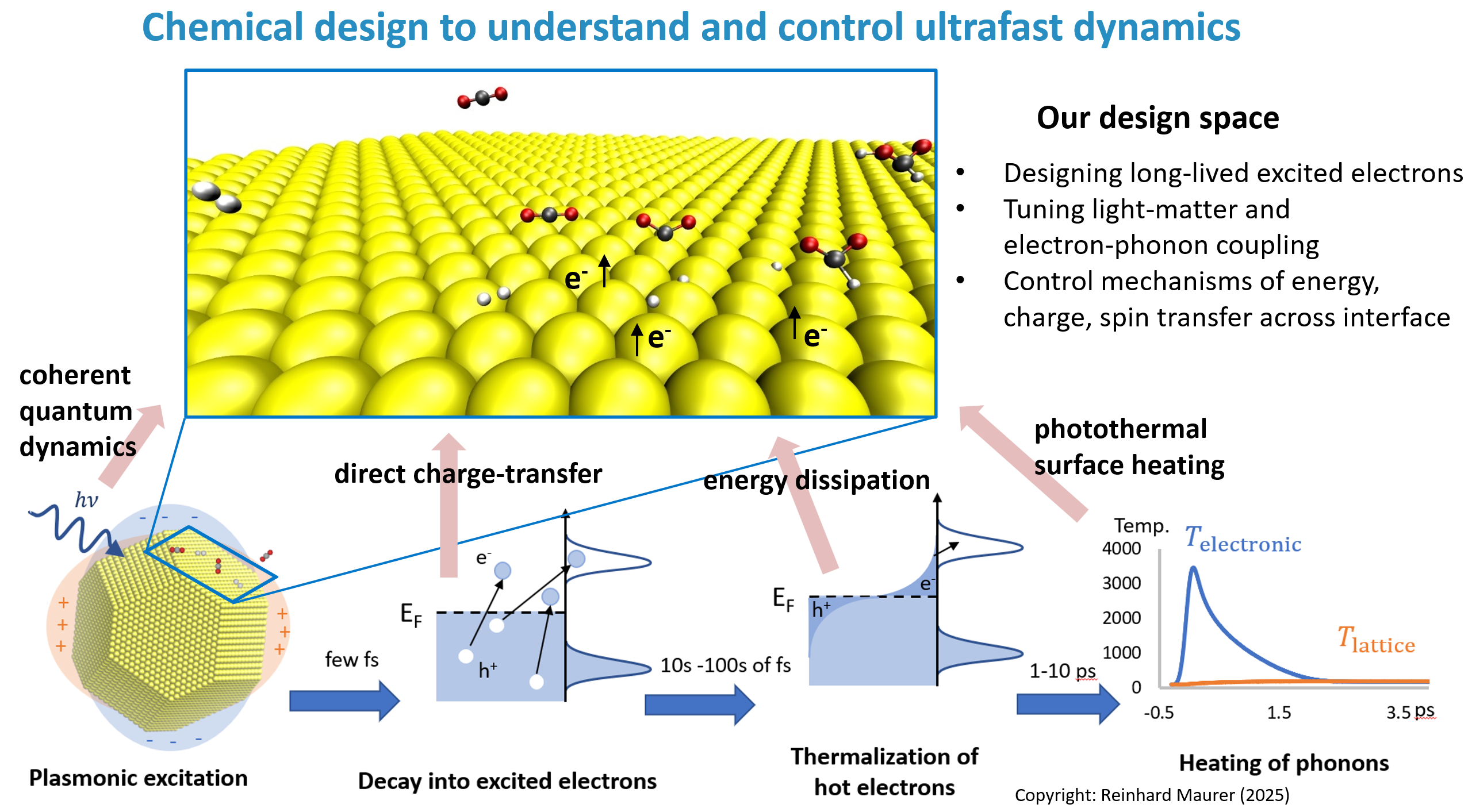
Explicit atomistic simulation of the dynamics of molecular reactions can help to gain valuable understanding of processes relevant to catalysis, surface chemistry, and surface scattering. Molecular dynamics on metal surfaces are especially interesting due to a variety of quantum and nonadiabatic effects that determine the qualitative and quantitative outcome of reactions. Such effects include non-adiabatic energy transfer between adsorbate motion and substrate electron-hole pair excitations leading to vibrational cooling of adsorbate motion or quantum nuclear effects that facilitate barrier crossings via tunnelling. Our current efforts are in developing methodology to include the above quantum effects in the study of non-equilibrium processes on surfaces.
Current Projects
- Development of improved mixed quantum-classical dynamics methods to study electronic transitions during reactive dynamics at surfaces
- Incorporation of spin and electron correlation effects in ultrafast dynamics
- Light driven hydrogen evolution chemistry at surfaces
- The role of thermal and non-thermal carriers in Plasmonic Photocatalysis
Collaborations
- Prof. Alec Wodtke, Max Planck Institute for Multidisciplinary Sciences and University of Göttingen, Germany
- Prof. Bin Jiang, University of Science and Technology (USTC), Hefei, China
- Prof. Michael Thoss, University of Freiburg, Germany