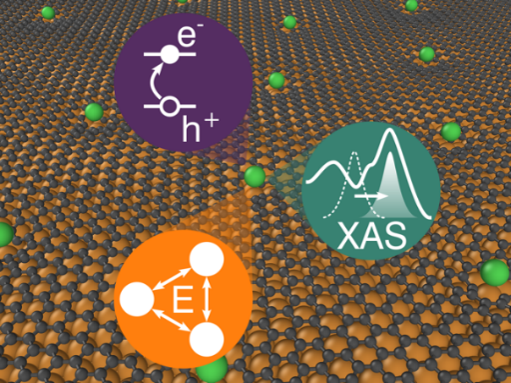
Fundamental to the design of functionalized surfaces and optically or electronically active hybrid interfaces is the understanding of the underlying interactions between substrate and adsorbate. Surface-sensitive spectroscopic methods such as x-ray photoelectron spectroscopy (XPS), near-edge x-ray absorption fine-structure spectroscopy (NEXAFS), x-ray standing wave measurements (XSW) and Scanning Tunneling Microscopy and Spectroscopy (STM/STS), play a key role in the characterization of adsorbate structure. These methods, together with nonlinear and ultrafast spectroscopy techniques such as Sum-Frequency Generation and Two-Photon-Photoemission have become the workhorses for the study of nanofunctionalised surfaces and 2D materials. We develop and apply techniques to simulate surface spectroscopy to enable the assignment of spectroscopic signatures to structural moieties. To describe ultrafast excited-state dynamics, we have developed a Density-Functional Theory-based method to calculate electronically excited states of metal-surface adsorbed molecules
Molecular Structure and Dynamics
We use advanced simulation techniques to study how molecules interact and evolve over time. Our research includes:
- Density Functional Theory (DFT): Quantum mechanical calculations of electronic structure
- Molecular Dynamics Simulations: Tracking atomic motions to understand reaction mechanisms
- Comprehensive surface structure determination: Predicting stable phases and thermodynamic properties at interfaces and in 2D materials
Machine Learning for Surface Chemistry
We develop ML models to accelerate computational chemistry:
- Neural network potentials for fast molecular dynamics
- Property prediction from molecular structure
- Automated reaction pathway discovery
The energy of a molecular system can be approximated using a neural network potential:
where is the atomic energy contribution and represents the local atomic environment.
Current Projects
- Developing machine learning potentials for catalytic reactions
- Simulating charge transfer at electrode-electrolyte interfaces
- Inverse design of molecules and materials with tailored electronic and optical properties
- Studying the controlled growth of two-dimensional materials
Computational Resources
Our research leverages high-performance computing clusters with thousands of CPU cores and GPU acceleration for quantum chemistry calculations and large-scale molecular dynamics simulations.
Collaborations
- Dr. David Duncan, University of Nottingham
- Dr. Alex Saywell, University of Nottingham
- Prof. Julie MacPherson, University of Warwick
- Prof. Michael Gottfried, University of Marburg
- Christian Wagner, Helmholtz Research Centre Jülich