Research Interests
Biography
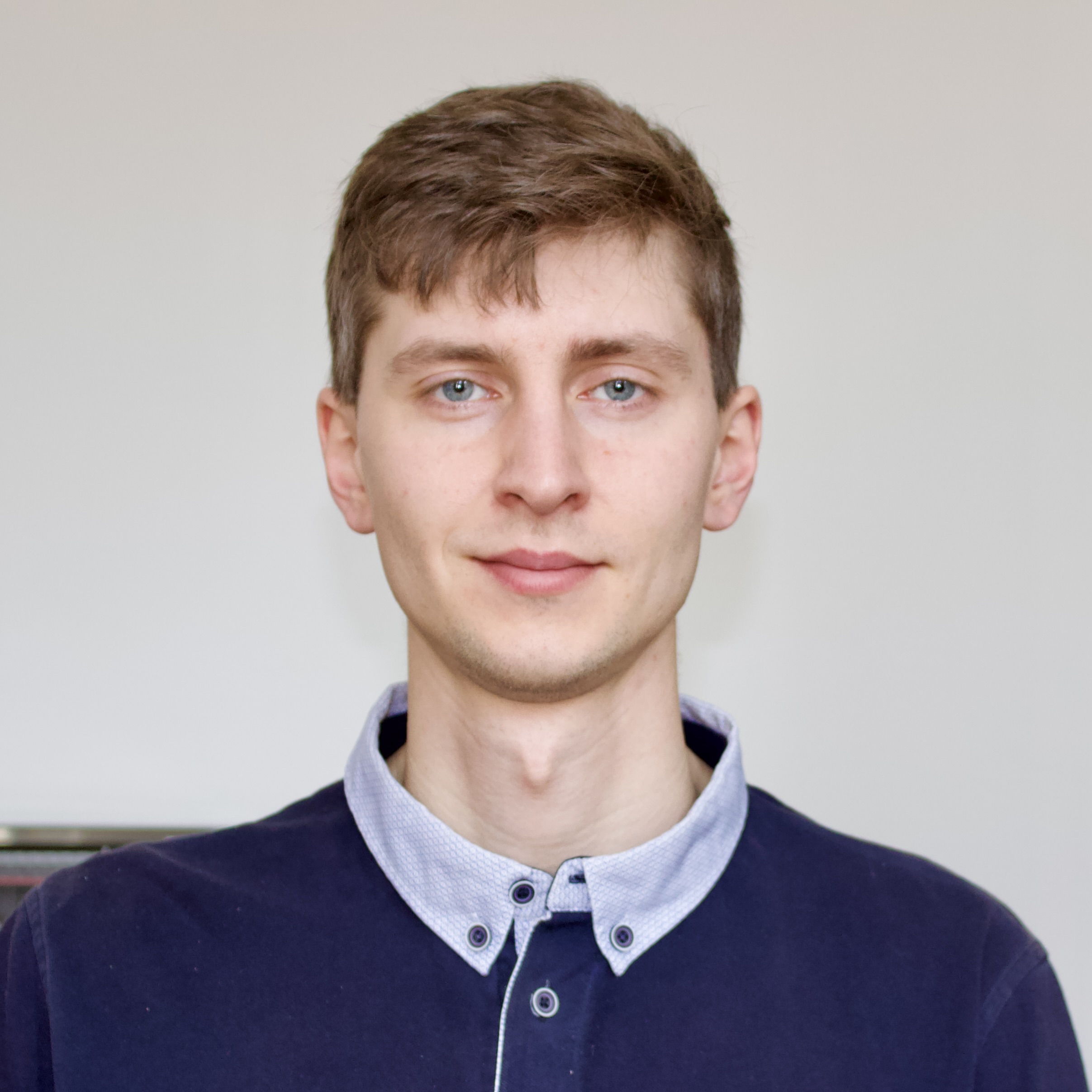
Fabian Jöbstl is a PhD student working on computational methods for light-driven and nonadiabatic processes at surfaces and interfaces. His research focuses on how electronically excited energy is redistributed between electrons, nuclei, and lattice vibrations, and how this governs chemical reactivity far from equilibrium.
PhD Research
Started: February 2026
Fabian’s doctoral research investigates nonadiabatic dynamics in surface chemistry, with an emphasis on electronically excited processes at solid–molecule interfaces. He studies how excited electronic states transfer energy to nuclear degrees of freedom beyond the Born–Oppenheimer approximation, spanning short-time nonequilibrium dynamics as well as longer-time regimes that can be described in terms of thermalized electron populations.
Research Approach
His work combines physics-based modeling with data-driven acceleration techniques, including:
- Nonadiabatic molecular dynamics using mixed quantum–classical approaches such as electronic friction and surface hopping
- Machine-learning-based surrogate models to reduce computational cost while retaining a physically meaningful description of the dynamics
- Applications to prototypical surface reactions relevant to catalysis and energy conversion
Background
Fabian holds joint bachelor’s and master’s degrees in physics from Graz University of Technology and the University of Graz, where he specialized in theoretical and computational physics. He completed his master’s thesis at the Institute of Theoretical and Computational Physics on first-principles studies of anharmonic lattice dynamics and dynamical stability in phonon-mediated superconductors, combining electronic-structure methods with machine-learning interatomic potentials. During his studies, he completed an Erasmus+ study stay at Delft University of Technology and carried out research work at Sapienza University of Rome as part of his master’s thesis.
Research Impact
Understanding how electronically excited energy is redistributed at surfaces is a central challenge in surface science and theoretical chemistry. By developing and applying computational methods for nonadiabatic dynamics in extended systems, Fabian’s work aims to provide microscopic insight into energy transfer mechanisms that govern reactivity, energy dissipation, and stability at solid–molecule interfaces.